For most of the last two decades, enterprise networking was built around a relatively stable set of assumptions. The majority of users worked from fixed office locations. Applications ran on servers that the organization owned and operated within a defined perimeter. Security teams built walls around that perimeter and trusted what was inside them.
Those assumptions no longer reflect how enterprises operate. The workforce became distributed. Applications moved to cloud platforms beyond the reach of on-premises security tools. Branch offices multiplied. Contractors, partners, and remote employees all needed access to the same systems that full-time staff used from headquarters. The perimeter did not disappear overnight, but it gradually became less meaningful as a concept and less reliable as a security boundary.
This shift is the core reason enterprises are replacing legacy architectures with a unified, cloud-delivered model that integrates networking and security. Understanding what drove that transition and what organizations gain from making it helps clarify why this architectural change is accelerating across industries of all sizes.
The Limits of Legacy Perimeter Architecture
Legacy network security was designed around physical presence. A firewall sat at the edge of the corporate network. Traffic entered and exited through that chokepoint, where it could be inspected and controlled. Users inside the perimeter were considered trustworthy by default.
This model created serious problems as enterprise environments evolved. When users began connecting from home networks and mobile devices, they could not receive the same level of security as those in the office without routing their traffic back through a central location first. That backhauling introduced latency and degraded the experience for users accessing cloud-hosted applications, which, by their nature, were designed to be accessed directly over the internet rather than through a data center hub.
Branch offices posed similar challenges. Each location required its own stack of networking and security equipment, routers, firewalls, and WAN optimization appliances configured and maintained by IT staff. As the number of locations grew, so did the operational overhead of keeping all of that hardware current, consistently configured, and properly monitored.
The underlying problem was structural. Legacy architecture could not scale gracefully to keep pace with the pace of change in enterprise environments. It required more hardware, more manual configuration, and more complexity with every additional location, user group, or cloud service.
What Changes When Enterprises Adopt a SASE Platform
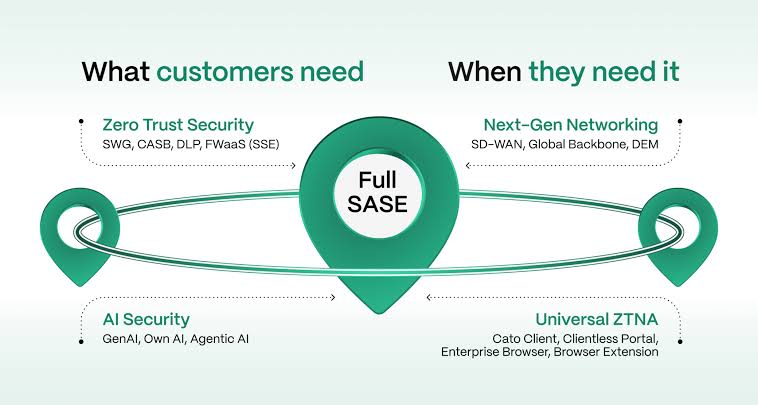
A SASE platform replacing legacy perimeter resolves these structural problems by moving both networking and security to a cloud-native architecture delivered from a globally distributed set of points of presence. Rather than routing traffic through a central data center for inspection, security controls are applied at the cloud edge, close to the user’s location.
For organizations with distributed workforces, this is a material operational improvement. A remote employee in one city and a branch-office team in another both connect to the nearest point of presence and receive the same security treatment under the same policy, without either experiencing the latency backhauling would impose. The architecture scales to accommodate new users and new locations without adding hardware.
SD-WAN capabilities within the SASE model allow organizations to manage traffic across multiple connection types, such as broadband, LTE, and others, and route that traffic intelligently based on application priority and real-time network conditions. This replaces rigid, hardware-dependent WAN configurations with flexible, software-defined routing that can adapt as conditions change.
Consolidation as a Strategic Driver
One of the most compelling reasons enterprises are making this move is the opportunity to reduce the number of separate tools their IT and security teams manage. A typical legacy environment might include standalone VPN concentrators, separate web filtering tools, independent firewall appliances at each branch, and a patchwork of cloud access controls built from multiple vendors.
Each of those tools has its own management interface, policy language, logging format, and update cycle. The cognitive and operational load of maintaining all of them simultaneously is substantial. When a security incident occurs, correlating events across those separate systems takes time that organizations often cannot afford.
A SASE platform replaces that fragmented collection with a single architecture sharing a unified policy engine and a common management console. Policy changes made centrally propagate consistently across all locations and users. Security event data from across the environment surfaces in one place, enabling faster detection and response.
This consolidation also affects budget planning. Rather than purchasing and renewing contracts for a collection of point solutions, organizations can move toward a single platform relationship with more predictable costs and clearer accountability.
Zero Trust Access as a Default
The transition to SASE also changes the default access model from one based on network location to one based on verified identity. Traditional VPN architectures granted users broad network access once they authenticated. If those credentials were compromised, an attacker could move laterally through the environment using the same access a legitimate user would have.
Zero trust network access, integrated as a core component of SASE, changes this by granting access to specific applications rather than to the network broadly. Every access request is evaluated against identity and device health checks before approval, regardless of its origin. Users are never placed on the wider network, only connected to the resources they are explicitly authorized to reach.
This model significantly limits the potential impact of compromised credentials. An attacker who obtains a valid username and password cannot automatically explore the broader environment. They are constrained to whatever the associated identity is authorized to access, and even that access is subject to continuous verification.
The evolution of vulnerability exploitation makes this architectural shift important to understand in context. Tracking how active exploits develop and spread is a priority for enterprise security teams. Resources like this active exploit tracking report from BleepingComputer illustrate the pace at which known flaws are weaponized and why access controls matter at every layer.
Operational Visibility Across a Distributed Environment
Enterprises with workforces and infrastructure distributed across many locations face a visibility challenge that legacy tools struggle to address. When network data and security event data live in separate systems, building a coherent picture of what is happening across the environment requires significant manual effort.
SASE platforms unify that data by design. Network telemetry and security events share the same data plane, which means the information is already correlated before anyone has to act on it. Anomalies surface faster, context is already available when they do, and the time between detection and response shortens accordingly.
For IT leaders navigating how to restructure infrastructure to support a distributed workforce, the operational complexity involved is well documented. A detailed look at what hybrid IT management demands in practice is available in this hybrid IT complexity guide from TechRepublic, which outlines how organizations can manage distributed environments more effectively.
Frequently Asked Questions
Why are enterprises replacing legacy perimeter security now rather than years ago?
The shift accelerated as cloud adoption and remote work became the norm rather than the exception. Legacy architectures were adequate when most users worked on-site and most applications were on-premises. As both conditions changed at scale, the performance and security gaps became too significant to patch with incremental upgrades.
Does moving to a SASE platform require replacing all existing infrastructure at once?
No. Most enterprises adopt SASE incrementally, prioritizing the locations or user populations where the gaps in the legacy architecture are most visible. Cloud-native delivery means new capabilities can be enabled without staging hardware, which gives organizations flexibility in how quickly they transition.
How does a SASE platform handle security for third-party users and contractors?
SASE applies the same identity-based access model to external users as to internal employees. A contractor is granted access to specific applications based on their defined role, with no exposure to the broader network. When their engagement ends, access is revoked through a single policy change rather than through manual updates across multiple systems.