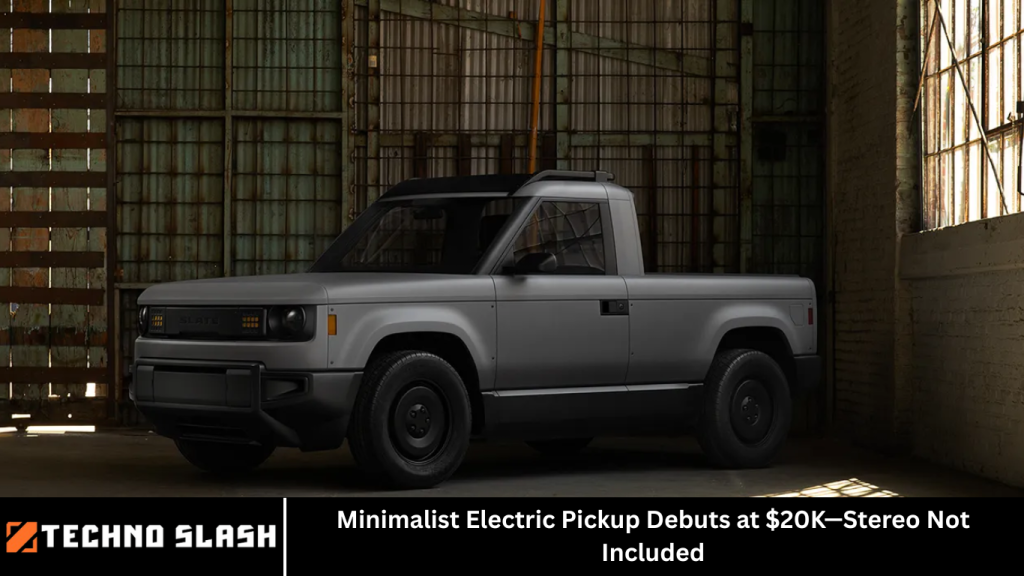
In an automotive world increasingly dominated by high-tech bells and whistles, one manufacturer has gone in the exact opposite direction. Enter the Telo M1, a minimalist electric pickup truck that strips away the non-essentials to deliver a bare-bones, no-nonsense EV utility vehicle for just $20,000.
You read that right—twenty grand for a brand-new electric truck. But there’s a catch: you won’t find a stereo, touchscreen, or even power windows.At a time when full-size electric pickups like the Ford F-150 Lightning and Tesla Cybertruck start north of $50,000 and can easily cross the six-figure threshold, the Telo M1 is a bold outlier
.
It’s compact, utilitarian, and unashamedly spartan. But does minimalist mean cheap and ineffective—or could this be a revolution in sustainable transport for the everyman? Let’s take a closer look at the stripped-down EV pickup that’s making waves.
More Read: Google Reverts Problematic Pixel Watch Update
The Vision Behind the Telo M1
The brainchild of a Silicon Valley startup, the Telo M1 was conceived to address two key problems in the current electric vehicle market: price and overcomplication. The founders argue that modern trucks are burdened with excessive tech, bloated dimensions, and frills that inflate costs and distract from what trucks were originally built to do—carry loads and go the distance.
By cutting out non-essential features and focusing purely on functionality, the Telo M1 aims to serve tradespeople, rural users, off-grid enthusiasts, and eco-conscious drivers looking for a dependable workhorse without all the fluff.
“Our philosophy is: If it doesn’t drive, haul, or tow—leave it out,” said Telo co-founder Ian Wright in a product demo. “We designed the M1 to be a real tool, not a toy.”
Design: A Return to the Basics
Visually, the Telo M1 is a stark contrast to the flashy, angular design language popular in modern pickups. It’s small—roughly the footprint of a Honda Civic—but with a high ride height and open bed reminiscent of a utility van.
The exterior is devoid of chrome, sharp creases, or faux-vent accents. The only hint of style is the vehicle’s color options, which include matte green, grey, black, and white—evoking the rugged simplicity of military or fleet vehicles.
The interior tells an even more radical story. Inside the cab, you’ll find:
- Two vinyl bucket seats
- A digital speedometer
- Manual windows
- A three-spoke steering wheel
- And—noticeably—no infotainment system.
There’s no stereo, no air conditioning, and no wireless charging. Just knobs for basic controls, a few power outlets for tools, and a ruggedized floor you can hose down.
It’s a pickup built for labor, not luxury.
Battery and Performance
While the Telo M1 may be minimalist in features, its powertrain is nothing to scoff at. The truck comes with a single electric motor driving the rear wheels, powered by a 35 kWh lithium iron phosphate (LFP) battery. This combination delivers:
- Range: Up to 125 miles on a full charge
- Towing capacity: 3,000 lbs
- Payload: 1,500 lbs
- Top speed: 75 mph
While those specs won’t compete with long-range EVs, they’re more than sufficient for daily work commutes, urban deliveries, and short-haul jobs. The LFP battery also boasts superior lifespan and safety characteristics compared to traditional lithium-ion packs.
Charging is just as straightforward as the rest of the truck. The M1 supports Level 2 AC charging, fully replenishing the battery in around 6 hours. There’s no DC fast-charging, which helps keep costs down.
Pricing: A Game-Changer at $20,000
The Telo M1’s headline feature is undoubtedly its price. Starting at $19,995, it undercuts every other electric pickup on the market by a massive margin.
How did Telo manage to achieve this?
- No infotainment system: Eliminates the cost of display screens, speakers, and connectivity software.
- No driver-assist features: You won’t find lane-keeping, adaptive cruise control, or collision detection.
- No luxury materials: The cabin uses durable, low-cost materials.
- Small size: Less raw material needed for manufacturing.
What’s more, the M1 is being offered direct-to-consumer, bypassing dealership markups. Customers order online, and the vehicle is delivered either to a service hub or to their address, depending on availability.
For those who want a slightly less rugged experience, Telo offers optional upgrades like:
- A basic stereo system ($250)
- Air conditioning ($500)
- All-wheel drive ($2,000)
Extended-range battery (+75 miles for $1,200)
Who’s It For?
The Telo M1 isn’t aiming to dethrone luxury trucks. Instead, it targets a specific segment of users who value function over form. Ideal buyers include:
- Contractors and tradespeople who need a low-cost, reliable utility vehicle
- Farmers and ranchers operating on large properties
- Fleet managers looking for eco-friendly work trucks
- DIY enthusiasts who want a simple, affordable EV
- First-time EV owners looking for an entry-level option
It’s also a smart choice for environmentally-conscious urban drivers who need hauling capacity but don’t want to pay for features they’ll never use.
The EV Market Disruption
The launch of the Telo M1 could mark a shift in how electric vehicles are perceived and priced. For years, EVs have been associated with premium pricing and luxury status. Even the so-called “affordable” EVs often start at $30,000 or more—out of reach for many working-class buyers.
The M1 challenges this model head-on. By demonstrating that an electric truck doesn’t need to be a rolling computer with a sound studio and gaming system, Telo opens the door for utility-focused EVs that prioritize affordability and accessibility.
Analysts predict that if the M1 succeeds, other manufacturers might follow suit. We could soon see a new category of “bare-bones EVs” entering the market—vehicles built not to impress but to perform.
Safety and Regulations
One area that often raises concerns with stripped-down vehicles is safety. So how does the Telo M1 hold up?
Despite its minimalist design, the M1 meets all federal crash safety standards. The vehicle comes equipped with:
- Front airbags
- A steel-reinforced safety cage
- ABS brakes
- Stability control
However, it lacks many of the advanced driver-assistance systems (ADAS) that are now common in newer vehicles. Telo defends this choice by arguing that such systems are often misused, misunderstood, or unneeded in work-oriented vehicles.
Still, for drivers used to modern digital aids, the transition might take some adjustment.
Environmental Impact
Another strong selling point of the Telo M1 is its low carbon footprint. The truck’s smaller size and battery mean less energy and fewer raw materials are used in production. Additionally, Telo is committed to:
- Using recycled materials wherever possible
- Manufacturing in a low-emissions facility
- Offering battery recycling programs
Compared to full-size electric trucks, which require enormous battery packs and metal-intensive builds, the M1’s streamlined footprint could make it one of the greenest EVs on the road.
The Verdict
The Telo M1 is not for everyone—and it doesn’t try to be. If you want heated seats, surround sound, panoramic sunroofs, and AI copilots, this isn’t your truck. But if you want a solid electric pickup for under $20K that can tow, haul, and handle rough jobs without breaking the bank, the M1 could be a game-changer.
It’s a bold bet on minimalism in a market obsessed with “more.” But sometimes, less is more—especially when it comes with zero emissions and a 4-digit monthly payment.
Frequently Asked Question
Does the Telo M1 come with air conditioning or heating?
By default, the M1 does not include air conditioning or climate control. However, customers can add an AC unit for $500. A basic heating system is included for winter comfort.
Can I add a stereo to the Telo M1?
Yes, a simple Bluetooth stereo package is available as an optional add-on for $250. It includes basic speakers and a dash-mounted controller.
How does the Telo M1 perform off-road?
While not built for extreme off-roading, the M1’s high ground clearance and optional all-wheel drive make it suitable for dirt roads, light trails, and farm terrain.
What is the vehicle’s warranty?
Telo offers a 3-year/36,000-mile basic warranty and an 8-year/100,000-mile battery warranty—comparable to industry standards.
Where is the Telo M1 manufactured?
The M1 is assembled in the United States at a facility in Nevada using both domestic and imported components.
Can I finance or lease the M1?
Yes, Telo partners with several online financing platforms. Lease and finance terms depend on credit approval and down payment.
When will deliveries begin?
Preorders are available now, with deliveries expected to start in Q4 2025. Early buyers may receive priority based on reservation date.
Conclusion
The Telo M1 is more than just an electric truck—it’s a philosophical shift in how we think about vehicles. In an age where technology often overshadows practicality, this no-frills pickup serves as a refreshing reminder that function can still reign supreme. With a base price of just $20,000, no touchscreen distractions, and a rugged, purpose-built design, the M1 redefines what it means to own a truck in the electric era. While it won’t suit every driver—especially those who prioritize luxury, tech, or long-range capability—it fills a crucial gap in the EV market: affordable, efficient, and honest utility. For tradespeople, eco-minded minimalists, and budget-conscious drivers, the Telo M1 might just be the simple, sustainable workhorse they’ve been waiting for.