Artificial Intelligence (AI) is no longer just a buzzword — it’s an essential driver of innovation in business across various industries. As AI technology continues to evolve and gain traction, companies are leveraging it to streamline operations, enhance customer experiences, and unlock new business opportunities.
This article explores how AI is transforming real-world businesses through 50 new stories of AI-driven innovation, offering insights into its practical applications and future potential.
More Read: AI Isn’t the Sole Driver of Innovation in 2025
The Rise of AI in Business
In the past few decades, we’ve witnessed significant shifts in technology that have transformed industries. From the rise of the internet to the explosion of mobile technology and the cloud, businesses have continuously adapted to stay competitive.
Now, we’re experiencing another major transformation: the shift to AI. AI encompasses a wide range of technologies, from machine learning and deep learning to natural language processing and robotics. These technologies enable machines to analyze vast amounts of data, learn from patterns, and make predictions or decisions with minimal human intervention.
With its ability to automate complex processes, enhance decision-making, and create personalized experiences, AI has become an indispensable tool for modern businesses.
New Stories of AI Transforming Real-World Businesses
In this section, we dive into 50 new stories that highlight how companies are using AI to revolutionize their operations, products, and services. These examples come from various industries, including retail, healthcare, finance, manufacturing, and more.
AI in Healthcare: Personalized Medicine at Scale
In the healthcare sector, AI is playing a key role in personalized medicine. AI algorithms analyze patient data, including genetic information, to recommend personalized treatment plans. A leading healthcare provider recently adopted AI to predict the most effective treatments for cancer patients based on their unique genetic makeup, improving patient outcomes and reducing treatment costs.
Retail: AI-Powered Customer Insights
Retailers are using AI to understand consumer behavior and provide personalized shopping experiences. A global retail chain implemented an AI-powered recommendation engine, resulting in a 20% increase in sales. The system analyzes customer browsing and purchase history to suggest products that are most likely to appeal to each shopper, driving conversions and improving customer satisfaction.
Manufacturing: Predictive Maintenance with AI
In manufacturing, AI is being used for predictive maintenance, helping companies reduce downtime and extend the lifespan of their equipment. A leading industrial manufacturer deployed AI-powered sensors to monitor machinery in real-time. The system predicts when parts will fail and recommends timely maintenance, reducing unplanned downtime by 30%.
Finance: AI for Fraud Detection
Financial institutions are leveraging AI to enhance security and detect fraud. One bank implemented AI-powered fraud detection algorithms to monitor transactions in real-time. The system identifies unusual patterns and flags potentially fraudulent activities, preventing millions of dollars in losses and protecting customers’ accounts.
Transportation: Autonomous Vehicles Revolutionizing Logistics
AI is at the heart of the autonomous vehicle revolution, particularly in the logistics and transportation sectors. A global logistics company has been testing AI-powered self-driving trucks for long-haul deliveries. Early results show that the technology could reduce delivery times by 15% and lower fuel consumption, significantly improving efficiency and reducing costs.
Customer Service: AI Chatbots Enhancing Customer Experience
AI chatbots are becoming increasingly popular in customer service, providing instant support and resolving issues around the clock. A leading telecom company introduced an AI-powered chatbot to handle routine inquiries, such as billing questions and service requests. The chatbot successfully resolved 70% of customer inquiries without human intervention, improving efficiency and customer satisfaction.
Marketing: AI-Driven Campaign Optimization
In the marketing industry, AI is transforming how campaigns are planned and executed. A digital marketing agency uses AI to analyze customer data and predict the most effective marketing channels and messages. This has led to a 25% increase in return on investment (ROI) for client campaigns, as AI enables more precise targeting and resource allocation.
HR and Recruitment: AI for Talent Acquisition
Human resources departments are utilizing AI to streamline the recruitment process. A global company implemented an AI-driven recruitment platform that screens resumes, assesses candidate fit, and even conducts preliminary interviews. This automation has reduced the time to hire by 40%, allowing HR teams to focus on high-value tasks like employee development.
Agriculture: AI for Crop Monitoring and Yield Prediction
In agriculture, AI is being used to monitor crop health and predict yields. A farm management company deployed AI-powered drones to scan fields and identify areas with pest infestations or water stress. By using AI to predict crop yields more accurately, farmers can optimize planting and harvesting schedules, leading to improved productivity and reduced waste.
Real Estate: AI-Powered Property Valuation
Real estate companies are using AI to automate property valuation and streamline the buying and selling process. An AI-driven platform analyzes various factors, including location, market trends, and property features, to determine the optimal price for a property. This has made property valuations more accurate and faster, benefiting both buyers and sellers.
Benefits of AI in Business
AI brings a multitude of benefits to businesses across industries. Some of the most significant advantages include:
Increased Efficiency and Productivity
By automating repetitive tasks, AI allows businesses to streamline operations and reduce manual effort. For example, in manufacturing, AI-powered robots can handle assembly tasks more quickly and accurately than humans, leading to higher productivity and fewer errors.
Better Decision Making
AI systems can process and analyze large volumes of data in real time, providing businesses with valuable insights that inform decision-making. Companies can use AI to forecast market trends, optimize supply chains, and improve financial planning.
Enhanced Customer Experience
AI enables businesses to provide personalized experiences to customers. Whether through AI-powered recommendation engines, chatbots, or personalized marketing campaigns, businesses can cater to individual preferences and deliver a more satisfying customer journey.
Cost Savings
AI can help businesses cut costs by automating processes, reducing waste, and optimizing resource allocation. In sectors like logistics, AI-powered route planning can help companies save on fuel and reduce operational costs. Additionally, predictive maintenance can lower the risk of costly equipment breakdowns.
Competitive Advantage
By adopting AI, businesses can stay ahead of the curve and gain a competitive edge. Companies that embrace AI can innovate faster, respond to customer needs more effectively, and adapt to market changes more easily, helping them outperform competitors.
The Future of AI in Business
As AI continues to evolve, its potential to transform businesses is immense. The future of AI in business will likely involve even more advanced capabilities, including:
- AI-Driven Decision Support: Future AI systems will go beyond providing insights and start making complex decisions autonomously, offering businesses real-time, data-driven solutions.
- AI-Powered Creativity: AI will enhance creative processes, such as designing products, creating marketing materials, and generating content, opening up new possibilities for innovation.
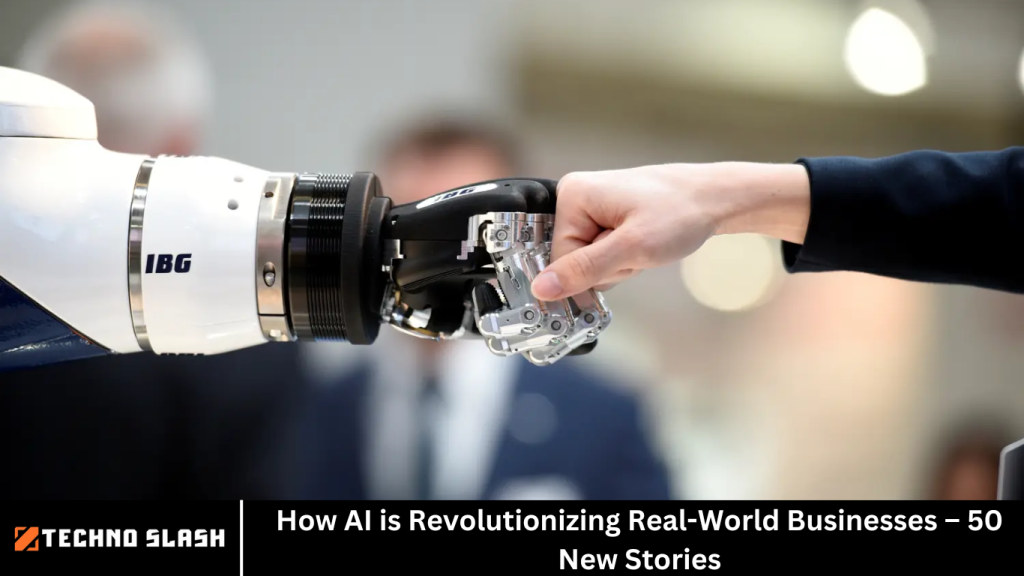
- Human-AI Collaboration: Rather than replacing human workers, AI will augment human capabilities. Businesses will increasingly rely on AI to handle repetitive tasks, allowing employees to focus on higher-level activities that require creativity and critical thinking.
Frequently Asked Question
How is AI transforming businesses across different industries?
AI is revolutionizing industries by automating tasks, enhancing decision-making, and improving customer experiences. In healthcare, AI helps with personalized medicine and predictive analytics. In retail, AI improves customer insights and enhances product recommendations. Manufacturing uses AI for predictive maintenance, while AI in finance helps detect fraud. Across sectors, AI increases efficiency, reduces costs, and drives innovation.
What are some examples of AI in business?
AI is being used in various business applications. For example, in customer service, AI-powered chatbots can handle routine inquiries. In retail, AI-based recommendation engines suggest personalized products to shoppers. In healthcare, AI algorithms help doctors diagnose diseases by analyzing medical images. Other examples include AI-driven predictive maintenance in manufacturing and fraud detection in banking.
How can AI improve customer experiences in business?
AI enhances customer experiences by personalizing interactions and providing immediate support. Through AI-driven recommendation systems, businesses can suggest products or services tailored to individual preferences. Chatbots and virtual assistants allow customers to receive fast, accurate answers to their inquiries, improving satisfaction. AI also helps businesses anticipate customer needs, offering personalized solutions that increase loyalty.
What industries are benefiting most from AI?
AI is benefiting various industries, including:
- Healthcare: For personalized treatment plans, disease detection, and drug discovery.
- Retail: To understand consumer behavior, optimize supply chains, and offer personalized shopping experiences.
- Finance: In fraud detection, risk assessment, and automated customer service.
- Manufacturing: Through predictive maintenance and improved supply chain management.
- Transportation: With autonomous vehicles and route optimization in logistics.
- AI’s versatility allows it to have a significant impact across almost every industry.
How does AI help businesses save costs?
AI can reduce operational costs by automating repetitive tasks, improving resource allocation, and minimizing human error. For example, AI-powered predictive maintenance in manufacturing helps businesses avoid costly equipment breakdowns by scheduling maintenance before issues arise. AI also optimizes supply chains, reducing waste and lowering inventory costs. In customer service, AI chatbots handle routine tasks, freeing up human employees for more complex issues.
Can small businesses benefit from AI, or is it only for large enterprises?
Small businesses can absolutely benefit from AI. Many AI tools are scalable and affordable, making them accessible to businesses of all sizes. For example, small businesses can use AI-powered chatbots to handle customer inquiries, AI-based marketing platforms to optimize advertising campaigns, or predictive analytics to forecast sales trends. AI tools for small businesses are increasingly user-friendly and don’t require extensive technical knowledge to implement.
What is the future of AI in business?
The future of AI in business looks promising. AI is expected to further enhance automation, with AI-driven systems making complex decisions in real time. There will be greater human-AI collaboration, with AI augmenting human skills rather than replacing them. Businesses will also explore more creative applications of AI, such as in design, content generation, and product development. As AI technology continues to evolve, it will play an even more integral role in business transformation across industries.
Conclusion
AI is already making waves in industries around the globe, transforming how businesses operate, interact with customers, and create value. The 50 stories shared in this article are just a small sample of the many ways AI is driving innovation in real-world businesses. As AI technology continues to advance, its impact will only grow, opening up new opportunities for businesses to increase efficiency, enhance customer experiences, and gain a competitive edge. For organizations looking to thrive in the age of AI, embracing these technologies is no longer optional — it’s a necessity. As we move forward, the potential for AI to revolutionize industries and reshape the future of business is boundless.