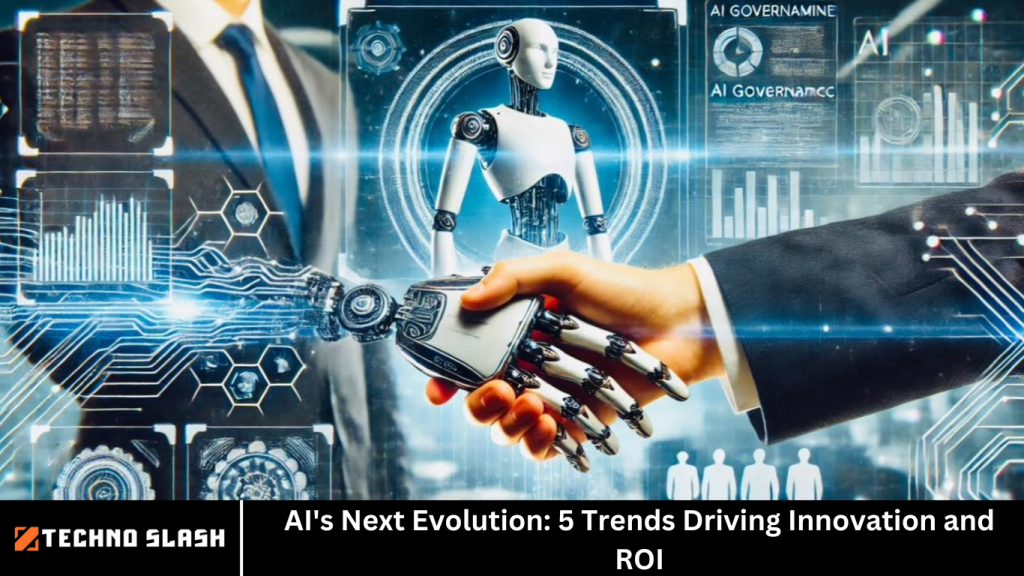
Artificial Intelligence (AI) is no longer just a buzzword or futuristic concept; it has evolved into a cornerstone of modern technological advancement. From business automation to decision-making, AI is reshaping industries, improving operational efficiency, and driving innovation.
With this ever-expanding role in business processes, AI is now being recognized as a key factor in delivering substantial return on investment (ROI). As AI continues to evolve, businesses must stay ahead of emerging trends to harness its full potential.
Explores the five key trends in AI’s evolution that are driving innovation and increasing ROI for businesses across sectors. By understanding these trends, companies can better position themselves to leverage AI effectively in the coming years.
More Read: AI Action Summit 2025: Shaping the Future of Artificial Intelligence
AI-Powered Automation: Revolutionizing Business Operations
AI-powered automation is one of the most transformative trends in the business world today. By automating repetitive and time-consuming tasks, AI allows companies to streamline their operations, reduce human error, and free up resources for more strategic endeavors.
AI’s automation capabilities extend across various domains, from customer service chatbots to robotic process automation (RPA) in back-office functions. RPA uses AI algorithms to handle routine tasks like data entry, invoice processing, and report generation.
By automating these tasks, companies can reduce operational costs and improve efficiency, leading to a direct impact on ROI. Moreover, AI-powered automation can significantly enhance customer experience (CX).
For example, AI chatbots and virtual assistants are now capable of handling customer inquiries, processing orders, and providing personalized recommendations, all while learning from each interaction.
This reduces the need for human customer service agents, cuts down wait times, and increases customer satisfaction, ultimately contributing to higher revenue and profitability. In industries like manufacturing, AI-driven robots and smart machines can handle tasks such as assembly line production, quality inspection, and inventory management.
This reduces labor costs, minimizes mistakes, and boosts production efficiency, making AI-powered automation a key driver of ROI in manufacturing and other sectors.
AI-Driven Personalization: Enhancing Customer Experiences
Personalization has become a critical component of customer experience in today’s competitive landscape. AI is helping businesses provide hyper-personalized experiences that cater to the unique needs and preferences of each customer.
This trend is evident across industries like e-commerce, entertainment, healthcare, and financial services. AI leverages vast amounts of customer data to identify patterns, predict behaviors, and offer tailored recommendations.
For instance, e-commerce giants like Amazon use AI to recommend products based on past purchases, browsing history, and even user behavior. By delivering highly relevant content and product recommendations, companies can increase conversion rates and drive higher sales.
In the entertainment industry, streaming platforms like Netflix and Spotify rely on AI to personalize content recommendations for their users. By analyzing user preferences and viewing habits, AI algorithms can suggest movies, TV shows, and music that are likely to resonate with individual users, keeping them engaged and increasing subscription renewals.
Personalization also plays a crucial role in digital marketing. AI-powered tools can segment customers based on their preferences, demographics, and online behavior, allowing businesses to deliver targeted ads and content that resonate with their audience.
This leads to higher engagement, better customer retention, and, ultimately, improved ROI. In healthcare, AI-driven personalization is helping doctors offer more accurate diagnoses and treatment plans based on individual patient data.
AI algorithms can analyze medical records, genetic information, and lifestyle factors to predict the most effective treatments, improving patient outcomes and reducing healthcare costs.
AI and Data Analytics: Turning Data into Actionable Insights
The sheer volume of data generated by businesses today is staggering, but raw data is only valuable if it can be analyzed and transformed into actionable insights. AI is playing a crucial role in making sense of big data and empowering organizations to make data-driven decisions.
AI-driven data analytics platforms use machine learning (ML) and deep learning algorithms to analyze large datasets and uncover hidden patterns, trends, and correlations. By doing so, AI helps businesses gain a deeper understanding of customer behavior, market trends, operational inefficiencies, and more.
For example, in retail, AI-powered analytics tools can help companies understand consumer purchasing patterns and optimize inventory management. By predicting demand, businesses can avoid overstocking or understocking products, ensuring that they meet customer demand while minimizing excess inventory costs.
In the financial sector, AI is helping institutions detect fraud and predict market trends. AI-powered algorithms can analyze transaction data in real time to identify unusual patterns that could indicate fraudulent activity, allowing businesses to take immediate action and prevent financial losses.
Similarly, investment firms use AI to analyze market data, predict stock movements, and make informed investment decisions, leading to improved portfolio performance. AI-driven analytics is also playing a major role in predictive maintenance across industries.
In manufacturing and energy, AI algorithms can monitor equipment health, predict when machinery is likely to fail, and schedule maintenance before costly breakdowns occur. This proactive approach reduces downtime, lowers maintenance costs, and improves overall operational efficiency, contributing to higher ROI.
AI and the Internet of Things (IoT): Creating Smarter Enterprises
The convergence of AI and the Internet of Things (IoT) is creating an ecosystem of connected devices that can communicate, share data, and make autonomous decisions. IoT devices, such as smart sensors, wearables, and connected machines, are generating vast amounts of data that can be analyzed and acted upon using AI.
In industries like manufacturing, logistics, and agriculture, the integration of AI and IoT is enhancing operational efficiency and enabling businesses to monitor and optimize processes in real time.
For example, in smart factories, AI-powered IoT sensors can monitor equipment performance, track product quality, and even predict when machines need maintenance, allowing for more efficient production and less downtime.
In supply chain management, AI and IoT are helping businesses track shipments, monitor inventory levels, and optimize delivery routes. By analyzing data from IoT sensors, AI algorithms can predict demand, identify potential supply chain disruptions, and suggest adjustments to ensure timely delivery and cost savings.
The healthcare sector is also benefiting from the combination of AI and IoT. Wearable devices, such as smartwatches and fitness trackers, are collecting data on patients’ health metrics, including heart rate, sleep patterns, and physical activity.
AI algorithms can analyze this data to provide personalized health recommendations, detect early signs of medical conditions, and alert healthcare providers to potential issues. Overall, the AI-IoT fusion is helping businesses create smarter, more connected enterprises that can optimize processes, reduce costs, and improve customer satisfaction, resulting in a significant ROI.
AI Ethics and Governance: Building Trust and Accountability
As AI continues to play a larger role in business operations, concerns around its ethical use, transparency, and accountability are becoming increasingly important. AI systems must be developed and deployed in a way that ensures fairness, reduces bias, and protects consumer privacy.
Organizations are recognizing the need to establish strong AI governance frameworks that prioritize ethical considerations. This includes ensuring that AI models are transparent and explainable, so businesses and customers can understand how decisions are being made. Additionally, companies must address issues related to data privacy, as AI systems rely heavily on large amounts of customer data to make decisions.
AI ethics also plays a role in reducing bias in algorithms. Machine learning models are only as good as the data they are trained on, and if the data contains biases, the AI system may replicate and even amplify those biases. Businesses must be proactive in ensuring that their AI models are fair and equitable, particularly in sensitive areas such as hiring, lending, and healthcare.
By addressing these ethical challenges, businesses can build trust with their customers and stakeholders, which can have a direct impact on long-term ROI. Transparent and responsible AI practices can lead to higher customer satisfaction, improved brand reputation, and greater regulatory compliance, all of which contribute to a positive financial outcome.
Frequently Asked Question
What are the five trends driving AI’s next evolution?
The five key trends shaping AI’s evolution are:
- AI-Powered Automation: Streamlining operations and reducing costs by automating repetitive tasks.
- AI-Driven Personalization: Enhancing customer experience with tailored recommendations and content.
- AI and Data Analytics: Turning vast amounts of data into actionable insights for improved decision-making.
- AI and the Internet of Things (IoT): Creating smarter, more connected enterprises that optimize processes in real time.
- AI Ethics and Governance: Ensuring fairness, transparency, and accountability in AI systems to build trust.
How does AI-powered automation increase ROI?
AI-powered automation eliminates the need for human intervention in repetitive tasks, reducing operational costs and human error. By automating processes like customer support, data entry, and even complex manufacturing operations, businesses can save time, reduce costs, and boost efficiency—leading to a more significant return on investment.
How can AI-driven personalization improve customer experience and ROI?
AI uses customer data to personalize experiences, from product recommendations to targeted advertisements. By tailoring the customer journey, businesses can increase conversion rates, improve customer retention, and drive higher sales, all of which directly contribute to a stronger ROI.
Why is AI’s role in data analytics important for business decision-making?
AI helps businesses analyze vast amounts of data quickly and accurately, uncovering hidden patterns and trends that may be impossible for humans to identify. These insights allow businesses to make data-driven decisions, optimize operations, improve customer targeting, and ultimately boost their ROI.
What is the impact of AI and IoT integration on business operations?
The integration of AI with IoT allows businesses to collect real-time data from connected devices and sensors, analyze it using AI, and make informed decisions. This leads to better process optimization, predictive maintenance, and more efficient supply chain management, all of which can significantly enhance ROI.
How do businesses ensure AI ethics and governance are part of their strategy?
Companies are increasingly focusing on AI ethics by implementing transparent, explainable AI systems, and ensuring that their models are free from bias. Strong governance frameworks are critical for addressing privacy concerns and ensuring that AI is used responsibly, which helps build trust with customers and stakeholders, contributing to long-term ROI.
What industries are seeing the greatest ROI from AI adoption?
AI is making a significant impact across various industries, including e-commerce, healthcare, finance, manufacturing, and entertainment. In e-commerce, AI helps with personalization, while in manufacturing, it’s improving automation and predictive maintenance. In healthcare, AI-driven analytics are enhancing patient outcomes, and in finance, AI helps detect fraud and optimize investments, all driving better ROI in these sectors.
Conclusion
AI’s evolution is marked by transformative trends that are reshaping industries and driving innovation at an unprecedented pace. From AI-powered automation to advanced data analytics and the integration of AI with IoT, businesses are finding new ways to enhance efficiency, improve customer experience, and generate higher ROI. As AI continues to advance, organizations must stay ahead of these trends and ensure that they are using AI ethically and responsibly to build trust and drive sustainable growth.